














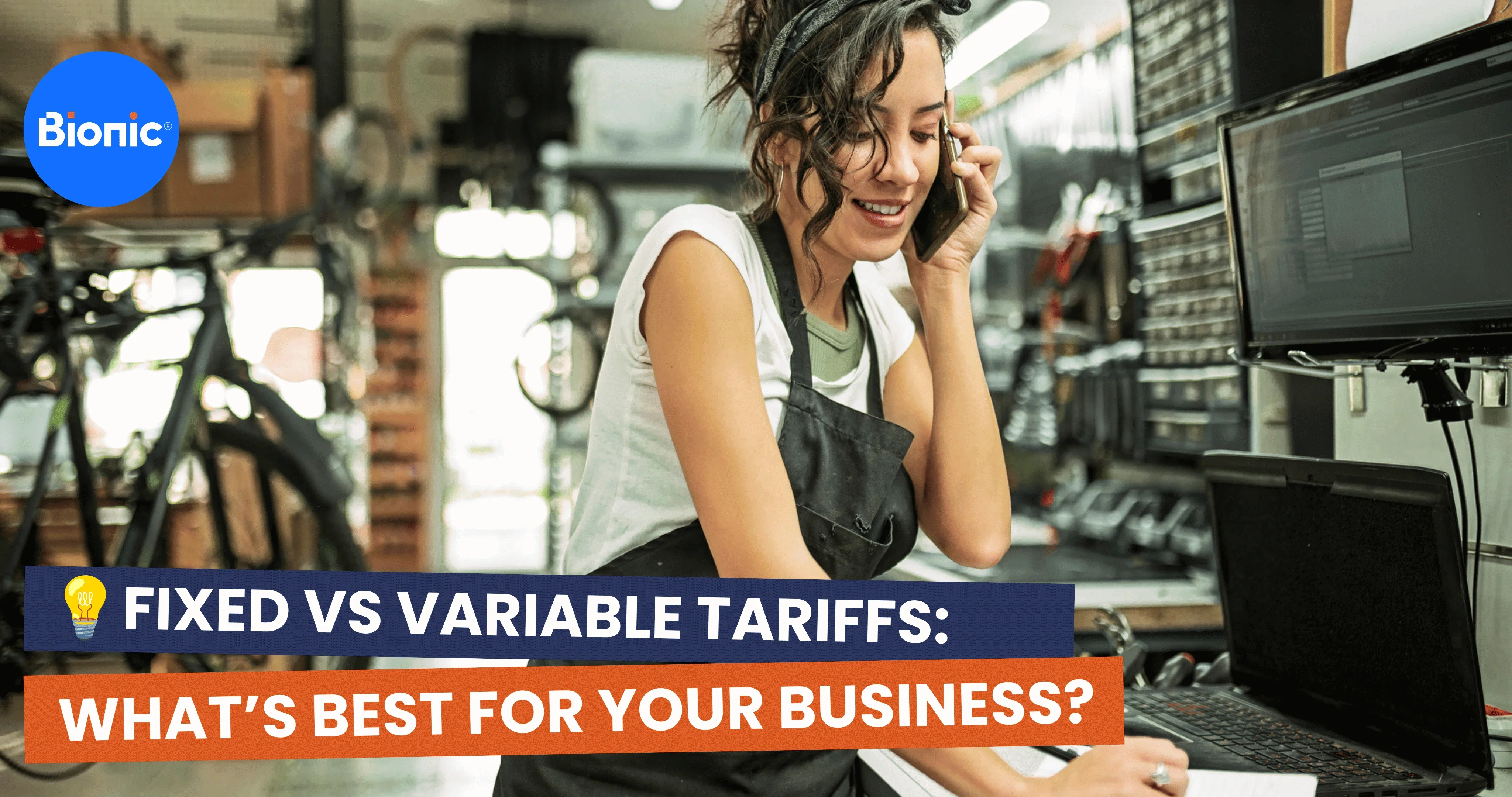
Fixed vs variable energy tariffs: Which is right for your business?


Choosing a business energy contract often starts with one question: lock in a rate, or let it move with the market?
Get it right, and you protect your margins for years. Get it wrong, and a bad winter for wholesale prices can wipe out savings you thought you'd secured.
In practice, most business energy suppliers in the UK offer fixed rate contracts. Fewer suppliers offer variable or part-variable deals, which means these deals can be harder to find and harder to compare.
This guide explains how fixed and variable business energy tariffs work. It also covers why fixed deals are the most common choice for UK businesses, and what to check before you sign.
Five-point summary of our fixed vs variable energy tariff guide
- Fixed tariffs lock your unit rate and standing charge for the contract term, giving predictable costs and protection from market spikes.
- Variable tariffs track wholesale prices, so your rates could rise or fall during your contract.
- Fixed tariffs are the most common business energy contract, as they offer more budgeting certainty and are more widely available.
- Contract length and exit fees differ. Fixed tariffs typically allow you to lock in rates for between one and three years (sometimes longer), while variable tariffs often allow easier switching.
- The right choice may depend on your cash flow, your appetite for risk and which tariffs suppliers can offer you.
What is a fixed energy tariff?
A fixed energy tariff locks in your rates for the contract term and protects you from price volatility. It’s the most common contract type for UK businesses buying business electricity, business gas, or both. The rates you agree at signing are the rates you pay throughout.
How does a fixed energy tariff work?
When you sign a fixed contract, your supplier buys the energy your business is forecast to use ahead of time. It buys this on the wholesale market, at the prices that apply on that day. That's why the rates quoted reflect wholesale prices on the day you sign, not the day you're actually using the energy.
Known as 'hedging', this is a type of buying strategy where a supplier buys energy in advance to lock in a price and limit exposure to market swings.
This is one reason why fixed rates can look expensive even when wholesale gas and electricity prices are falling. Your supplier bought at the rate that applied months earlier and needs to recover that cost regardless of what the market is doing today. It's a trade-off: you give up the chance of catching a sudden price drop in exchange for knowing exactly what you'll pay.
You can find out more in our guide to how energy is bought and sold.
Why are most business energy contracts fixed?
Fixed contracts are the standard offer from most UK business energy suppliers. There are a few reasons for this.
Fixed pricing matches how suppliers buy energy
Suppliers usually buy energy for business customers ahead of time. A fixed price lets them match what they charge you to what they paid. This makes fixed deals simpler for suppliers to offer and price.
Most UK businesses are small and value predictable bills
Most UK businesses are run by very small teams. At the start of 2025, there were an estimated 5.7 million private sector businesses in the UK, and 75% did not employ anyone aside from the owners.
If you run your business alone or with a partner, a fixed price could mean less time checking bills. It also means you probably don’t have to watch the wholesale market.
Variable and flexible deals tend to suit larger energy users
Variable and flexible buying options are more often aimed at larger businesses with high energy use. These businesses may have staff or consultants who track the market for them, and energy contracts often go through a tender and procurement process. You can learn more in our guide to large business, industrial and high usage energy.
This service isn't usually offered to micro and small businesses, unless they have particularly high energy use.
The benefits of a fixed tariff contract
- Greater budgeting certainty - your unit rate and standing charge stay the same for the whole term
- Protection from price volatility - a sharp rise in wholesale prices won’t change your rate mid-contract
- Less admin - you won’t need to monitor the market or check for rate changes
- More choice - most UK suppliers offer fixed deals, so you can compare more quotes side by side
- Clear renewal dates - you know exactly when your contract ends and when to start comparing
What is a variable tariff?
A variable tariff takes the opposite approach. Instead of locking a rate, it tracks the market. Variable tariffs are far less common for business energy, and only a small number of suppliers offer them.
With a variable tariff, your unit rate can change during your contract, usually in line with movements in the wholesale energy market. There's no fixed price for the energy you use, which can even fluctuate within the same billing cycle.
How does a variable tariff work?
Your supplier reviews wholesale prices on a set schedule and adjusts your rate to match. The schedule varies, but monthly or quarterly is common. If wholesale prices fall, your rate may fall too. If they rise, your bill might too.
It’s worth being precise here, because it changes how much protection you actually have. A genuine variable tariff is one you've chosen and agreed to.
A deemed rate or out-of-contract rate isn't the same thing. These are default rates that you're automatically placed on if no contract is in place. These are almost always the most expensive option. Choosing a variable tariff is one decision. Drifting onto one by accident is often a mistake, and a much more costly one.
What is a part-variable tariff?
A part-variable tariff is a type of business energy contract where some costs are fixed, but others can change during the term. For example, part of your price may be fixed while other parts follow the market. The split differs between suppliers. You should consider asking for a clear breakdown of which costs could change before you sign.
Are variable tariffs easy to find for small businesses?
Not usually. Most UK suppliers offer fixed contracts to small and micro businesses. Variable and part-variable deals are less common, so you may only see one or two options. That makes it harder to compare prices and terms like-for-like. Most deals on Bionic’s supplier panel are fixed-rate contracts, and part-variable options are limited.
Fixed vs variable business energy tariffs - what's the difference?
Line them up side by side, and it really comes down to three things:
- How predictable you need your costs to be
- How long you're prepared to be tied in
- How much wholesale risk you're willing to carry.
There’s also a fourth, practical point: fixed deals are often much easier to find and compare.
Price stability and budgeting
A fixed tariff gives you a number to plan around. If you know your unit rate for the next two years, you can forecast overheads, price your own products or services with confidence, and avoid the mid-year surprise of a supplier hiking your rate. A variable tariff removes that certainty. You may need to build in more financial headroom, because the rate you're quoted this month may not be the rate you're paying by next quarter.
Contract length and flexibility
Fixed deals typically run for one to three years, but can last for up to five years. When you sign, you're committed to that supplier and that rate for the duration. Commercial energy contracts can be difficult to leave early, so make sure you're happy with the contract before you sign. For more info, check out our guide to switching business energy contracts early.
Variable tariffs may be more flexible on notice periods, as the supplier has less to lose if you switch away. Terms vary, though, and few suppliers offer variable deals to smaller businesses.
Exposure to wholesale market prices
On a fixed deal, your supplier has already bought your energy ahead of time. They absorb the wholesale swings, and you don’t feel them until renewal, for better or worse.
On a variable deal, you carry that exposure yourself. Most of the time that's fine. During a genuinely volatile stretch, it can move your bills a lot, in either direction, as Ofgem's wholesale market data shows over the past few years.
For more information on what’s going on with energy prices, see our guide ‘Why Are Energy Prices so High?’.
Availability and choice
Most UK business energy suppliers offer fixed contracts. Far fewer offer variable or part-variable contracts to small businesses. With fewer quotes on the table, it can be harder to judge whether a variable deal is good value.
What are the pros and cons of a fixed energy tariff?
Fixed contracts are the most widely used type of business tariff, but they do have some downsides. You should consider the pros and cons before you sign.
Pros:
- Predictable costs make budgeting and pricing far easier
- Protection against mid-contract price rises, even during periods of market volatility
- Widely available, with the most competitive rates typically found through comparison rather than accepting a renewal quote
- No surprises on your bill beyond changes in your own usage
- Less admin, as you don’t need to track wholesale prices during your contract
- Easier to compare, as most suppliers quote fixed prices on the same basis.
Cons:
- You won't benefit if wholesale prices fall after you've signed
- Leaving early usually means paying an exit fee
- Locking in during a period of high wholesale prices means you're stuck with that rate until your renewal window opens
- Contracts of three to five years reduce your flexibility to switch supplier or renegotiate
What are the pros and cons of a variable tariff?
Variable tariffs don’t offer the certainty of a fixed contract, but they do have some advantages. You should consider the pros and cons, and how many options are open to you, before you commit.
Pros:
- You benefit immediately if wholesale prices fall
- May come with shorter commitments and fewer or no exit fees
- Can suit businesses with genuinely unpredictable or seasonal energy use
- Useful as a short-term bridge while you decide on a longer fixed deal
Cons:
- Bills can rise sharply and with little warning during volatile periods
- Harder to budget accurately, especially for smaller businesses with tighter cash flow
- Variable arrangements can include expensive deemed or out-of-contract rates in disguise
- Requires more active monitoring to make sure you're not overpaying
- Offered by few suppliers, so you may have limited quotes to compare
How to compare fixed vs variable business energy tariffs
If a variable or part-variable option is available to you, you could compare it with fixed quotes using the same estimated annual consumption. In practice, most quotes for smaller businesses will be fixed. You may find yourself comparing several fixed deals rather than both types.
Look beyond the headline unit rate too. Contract length, exit fees, and standing charges all affect the total cost, and a slightly higher unit rate on a shorter, more flexible contract can sometimes work out better than a longer fixed deal with a lower rate but rigid terms.
How to compare fixed rate business energy deals
Because most business energy contracts are fixed, these checks could help you compare like-for-like:
Unit rate
The unit rate is the price you pay for each kWh of energy you use. On a fixed contract, it stays the same for the whole term. A lower unit rate could matter most if your business uses a lot of energy
Standing charge
The standing charge is a daily fee you pay to stay connected to the grid, whatever your usage. It can vary a lot between suppliers. If your usage is low, the standing charge could make up a large share of your bill.
Contract length
Fixed contracts typically run for one to five years. A longer term gives you more price certainty, but less flexibility to switch. You should consider how settled your business plans are before choosing a term.
Exit fees
Most fixed contracts charge a fee if you leave before the end date. You should consider checking how much this could be before you sign. It may matter if you’re planning to move premises or change how your business runs.
Renewal window
Your renewal window is the period when you can start comparing deals before your contract ends. Your bills and renewal letters usually show your contract end date. If you miss it, you could drift onto expensive deemed or out-of-contract rates.
Total annual cost
The cheapest unit rate doesn’t always mean the cheapest deal. You should consider using your actual annual usage to work out what each quote could cost you in a year. Include the unit rate and standing charge, so you can see the full picture.
How to compare variable energy tariffs
If you’re offered a variable or part-variable deal, a few quick checks could tell you whether it’s competitive. Bear in mind that few suppliers offer these to smaller businesses, so you may have little to compare it against.
Check how often the rate can change
Ask your supplier exactly how frequently they review and adjust variable rates. Monthly reviews mean more responsiveness to falling prices, but also more frequent exposure if prices rise.
Look at the supplier's pricing history
A supplier's track record on variable pricing tells you more than their current rate. Ask for historical pricing data, or check independent sources, to see how sharply their rates have moved during past periods of market volatility.
Read the small print on notice periods
Some variable contracts carry longer notice periods than you'd expect, even though the whole appeal of a variable deal is flexibility. Confirm the exact notice period and any conditions attached to switching away.
On a part-variable deal, some costs stay fixed and some move. You should consider asking which parts could change, and how often.
Which tariff is right for your business?
There's no single answer to whether fixed or variable energy is better. It depends on your business's tolerance for risk, the stability of your cash flow, and how confident you feel reading the wholesale market.
It also depends on what suppliers can offer you. For most small UK businesses, a fixed tariff is the most widely available option.
When a fixed tariff makes sense
A fixed tariff makes sense if you value certainty over the possibility of catching a lower rate. This tends to suit businesses with tight margins, fixed pricing commitments to their own customers, or a preference for not thinking about energy markets once the contract is signed.
It may also suit you if you run your business alone and want less energy admin.
When a variable tariff may suit a business
A variable tariff may suit you if your business can absorb some change in costs and you’re actively monitoring the market. It could also suit you if you want the flexibility to switch quickly. Variable deals are not widely offered to smaller businesses, so you may have limited options.
Why compare business energy tariffs with Bionic?
Bionic compares quotes from trusted UK suppliers, so you don’t have to contact each one yourself. Most deals on our panel are fixed-rate contracts, giving you price certainty for the whole term.
Part-variable options are limited. If one is available for your business, our energy experts will explain how it works. When you get a quote with Bionic, we walk you through the options so you can choose the contract that suits your business.
Fixed and variable energy tariffs FAQs
Still not sure whether fixed or variable is best for your business? Check out the answers to some of the most frequently asked questions below:
What is a fixed business energy tariff?
A fixed business energy tariff is a type of contract that sets your unit rate and standing charge for the whole term. Your bill only changes if your usage changes. Fixed tariffs are the most common type of business energy contract in the UK.
What is a variable business energy tariff?
A variable business energy tariff is a type of contract where your unit rate can change in line with wholesale prices. Your costs could rise or fall during the term. Few suppliers offer variable tariffs to smaller businesses, so they may be harder to compare.
Is a fixed or variable tariff cheaper for businesses?
Neither is always cheaper. A variable tariff may cost less if wholesale prices fall, but it could cost more if they rise. A fixed tariff gives you price certainty instead. For most small businesses, fixed deals are also easier to find and compare.
Can I switch from a fixed to a variable tariff early?
Yes, but most fixed contracts include exit fees that can make early switching costly. You should consider checking your contract terms before making any changes. Variable tariffs are also less widely available, so you may have few options to switch to.
How often do variable energy rates change?
Variable rates are typically reviewed monthly or quarterly, depending on the supplier. Your supplier should tell you how often your rate can change. You should consider confirming this in writing before you sign.
Are deemed or out-of-contract rates the same as variable tariffs?
No. Deemed or out-of-contract rates are default rates a supplier charges when you have no contract in place. They are usually more expensive than agreed tariffs. A variable tariff is a contract you have chosen and signed.
Which tariff is better for budgeting?
Fixed tariffs are generally better for budgeting. Your unit rate and standing charge stay the same, so only your usage changes your bill. This could help you plan your cash flow with more confidence.
Why are most business energy contracts fixed?
Suppliers usually buy energy for business customers ahead of time, which suits fixed pricing. Fixed rates also give small businesses predictable bills and less admin. As a result, most UK suppliers focus on fixed contracts, and variable deals are less common.