













Why are energy prices so high? Are they still going up?


Energy rates have fluctuated across 2026, with both gas and electricity rates quoted by Bionic coming down in August, compared with July.
Since then, wholesale gas prices have climbed again. UK wholesale gas rose above 217p per therm (around 29 kWh) on October 19, 2026. Renewed attacks on tankers in the Strait of Hormuz pushed up supply fears.
But, as we outline below, geopolitical events can be a big driver of prices, so we could see more price volatility while the Middle East remains unstable.

Five-point summary of our guide on rising energy rates
- After huge spikes in 2022, energy prices levelled off across 2023 and 2024. However, they are still significantly higher than pre-pandemic levels, and experts predict they may not return to those lower levels for the rest of this decade.
- Unlike household energy, business energy prices have never been protected by a price cap. While government support schemes like the Energy Bills Discount Scheme helped from 2022 to 2024, there is now no ongoing support for business rates.
- Events like the war in Ukraine, the conflict involving Iran, shipping disruption in the Strait of Hormuz, lower renewable generation, storage shortages and supply chain issues have all kept energy costs high. Global gas prices and oil markets still have a big influence on UK energy bills.
- Energy suppliers buy energy ahead of time (hedging) to protect against volatility. This means current bills often reflect earlier, higher buying prices. Suppliers also factor in risk, which keeps prices higher even as the wholesale market falls..
- Locking in a competitive fixed-rate contract could help protect your business from future price rises. Energy-saving measures, smart meters and comparing deals regularly could also help cut costs over time. |
What is the energy price cap?
The latest energy price cap review means higher rates for millions of households. Ofgem raised the cap by 4% from 1 October 2026, to £1,729 a year for a typical household. But remember, the price cap has no direct impact on business energy rates.
The energy price cap limits what suppliers can charge households for each unit of gas and electricity. Set by Ofgem, it covers household standard variable tariffs only. It does not cover business energy contracts.
The energy rates you pay are largely based on wholesale prices in the live market. These prices change frequently, and there's no way to be certain whether they'll go up or down. But the level of the domestic cap can give an idea of where prices are heading.
Although not directly connected to business energy rates, the latest rise suggests wholesale costs are climbing again. If your business energy deal is up for renewal, consider comparing prices to see what rates you could lock in.
What are wholesale energy prices?
Wholesale energy prices are the market price that suppliers pay for gas and electricity before selling it on to you. They change every day. They make up a large part of the rates on your business energy bill.
Now let's take a closer look at why prices have been so volatile, what current rates look like, whether you should fix your rates, and more.
What are the latest business gas and electricity rates?
The rates your business pays for energy depend on your business size and type, the amount of energy it uses, and when and how you use it. Location also affects the rates you pay.
Visit our business gas and business electricity pages to learn each supplier's latest business gas rates and each supplier's latest business electricity rates.
Why are business energy prices rising in 2026?
Energy prices fell steadily across 2023 and into 2024. The energy market had returned to a relatively normal state with none of the volatility we saw in 2022, and prices have stabilised. This was how things worked before Covid and prior to the price spike, as you can see from the graphs on the Ofgem website.
But price volatility has returned. The situation in the Middle East is creating uncertainty in global gas supply routes, leading to price rises. This is because UK business energy prices tend to reflect the wholesale price of oil and gas. Tensions in the Middle East have pushed both global gas and oil prices up, which historically drives higher energy prices here in the UK.
Conflict in the Middle East is currently driving energy market volatility. The pressure has carried on since the spring. By late September 2026, UK wholesale gas prices were up around 160% from the start of the year.
UK Gas storage levels
Britain has limited gas storage, so it relies heavily on liquefied natural gas shipped in from abroad. As you can see from the graph below, 2026 gas storage levels are well below those of previous years.
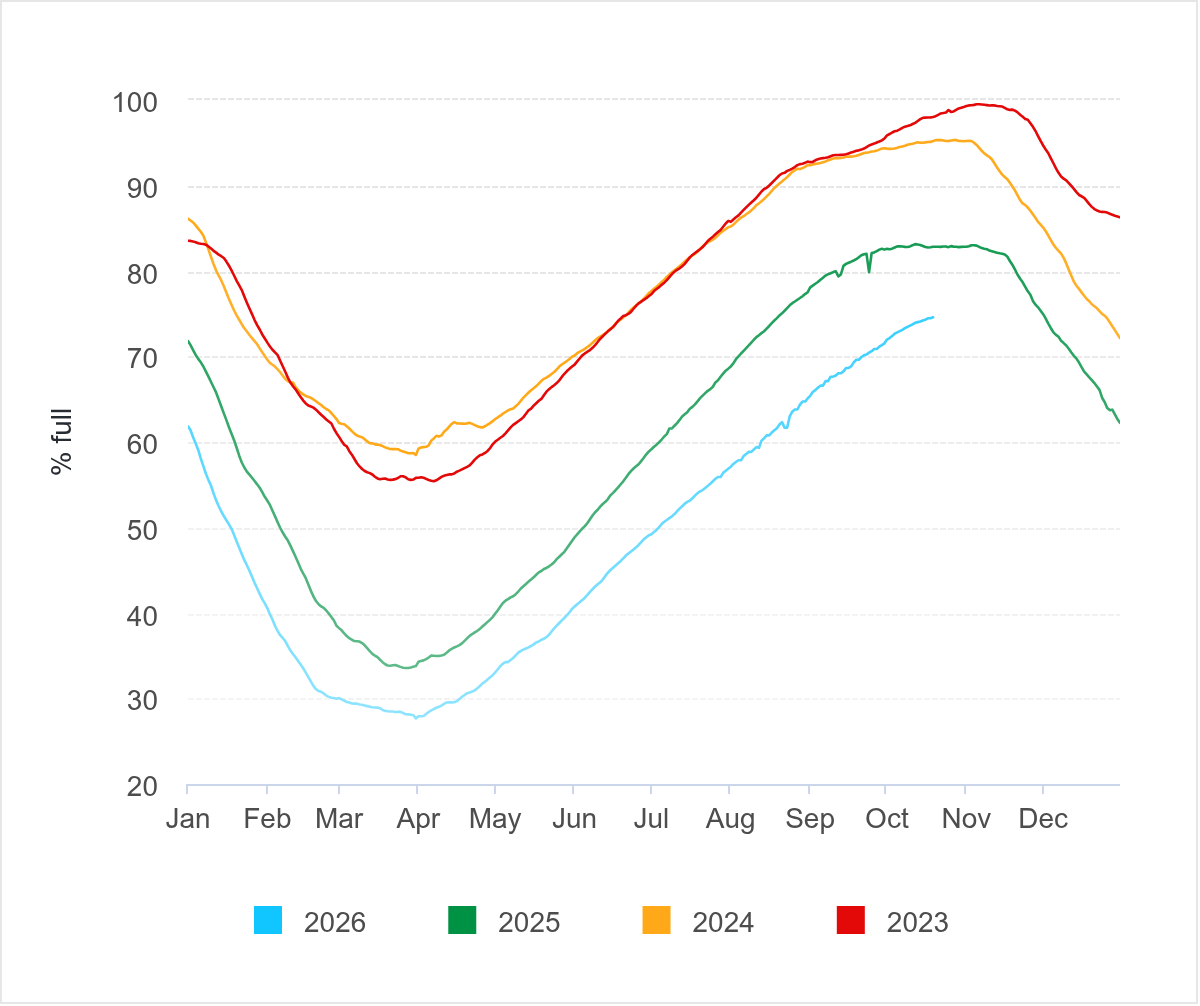
The UK's current storage is considerably less than its northern European neighbours. It currently has less than half the storage of France and Italy and a third less than Germany and the Netherlands.
UK imports of liquefied natural gas fell 22% between April and June 2026, compared with a year earlier. Shipments from the USA and Qatar dropped by 44% and 39%.
What is liquefied natural gas (LNG)?
Liquefied natural gas is a type of natural gas cooled into a liquid so ships can carry it. The UK imports LNG from countries such as the USA, Qatar and Norway.
Why did energy prices increase so much in 2022?
Wholesale energy prices rose by more than 500% year-on-year between August 2021 and August 2022. A relatively mild winter across the UK and much of Europe, coupled with the energy-saving efforts of homes and businesses worried by the prospect of unaffordable energy bills, helped to cut demand and caused a drop in prices across 2023.
The energy market was also hit by the shocks of Russia's invasion of Ukraine, the closure of Nord Stream 1, and other infrastructure issues. These events had a huge impact on prices, but this was lessened when European countries cut their reliance on Russian gas by filling storage facilities with liquefied natural gas from across the globe.
Prices continued to fall across 2023 but rose steadily across 2024. And even though prices have fallen, they're still around 50% higher than at the start of 2021. Wholesale prices are still higher than pre-pandemic levels, and the experts at Cornwall Insight, energy market intelligence analysts, have suggested that prices might not return to pre-pandemic levels this decade.
Although wholesale prices have fallen, energy is still very expensive.
Alex Staker, Head of Commercial Operations at Bionic, explains why these price drops aren't always passed on to customers: "It's to do with the way energy is bought and sold and the risk associated with this process. To be able to offer fixed rates, energy suppliers need to buy power in advance of selling it to customers. This means the rates at which they have bought wholesale energy to sell today might differ from the current wholesale rates.
"Suppliers also need to factor risk into their price calculations, in much the same way as finance providers factor risk into the prices they charge for credit.
"Energy suppliers are continuously buying energy to make sure there's enough to cover demand. If demand exceeds supply, then they need to buy more at current market prices to cover the shortfall. But if supply exceeds demand, then suppliers need to sell the excess energy back to the grid - if the day-ahead price is lower than the price they bought the energy for, then they'll lose money.
"When the market is so volatile, the risk to suppliers is greater and so prices go up. And this is also part of the reason why it can take time and a consistent run of lower rates for any price drops to be passed on to customers."
What is hedging?
Hedging is a type of forward buying where suppliers lock in energy prices months or years ahead. It protects suppliers and customers from sudden price swings. But it also means price falls take time to reach your bill.
You can learn more in our guide to how energy is bought and sold.
How much are wholesale energy prices right now?
The latest Trading Economics figures show the current cost of UK natural gas futures for the next month forward delivery contract rates (which are the wholesale prices that suppliers typically pay for the energy they supply to customers on fixed rate contracts) for gas and electricity are:
- Wholesale gas costs around 218p per therm* (around 29 kWh)
- Wholesale electricity costs around £144 per MWh* (1,000 kWh)
Prices correct as of 8 am on October 20, 2026.
Are energy prices still rising in 2026?
In short, yes, for now. Wholesale gas prices rose again through September and October 2026. Analysts at the Oxford Institute for Energy Studies warn gas prices could climb further this winter without a deal to reopen the Strait of Hormuz. On the flip side, they also say a full return of LNG shipments from Qatar could trigger a sharp fall.
Energy prices fell in early 2025 following a period of relative stability and slight increases. Prices fell as we entered 2026, but we've entered another period of volatility due to the conflict in Iran. This has caused price spikes for both gas and electricity, as the graphs below show.
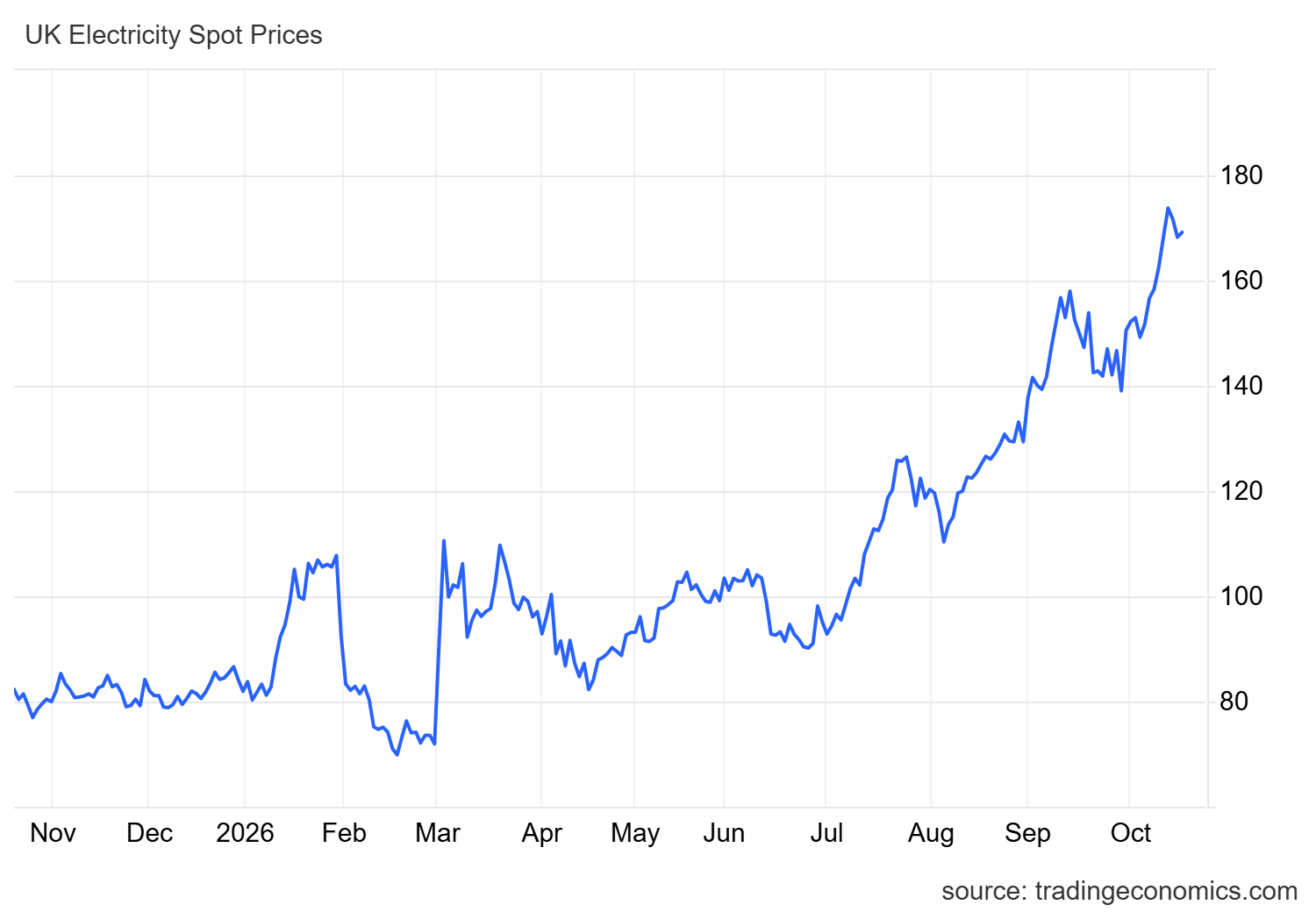
Source - Trading Economics
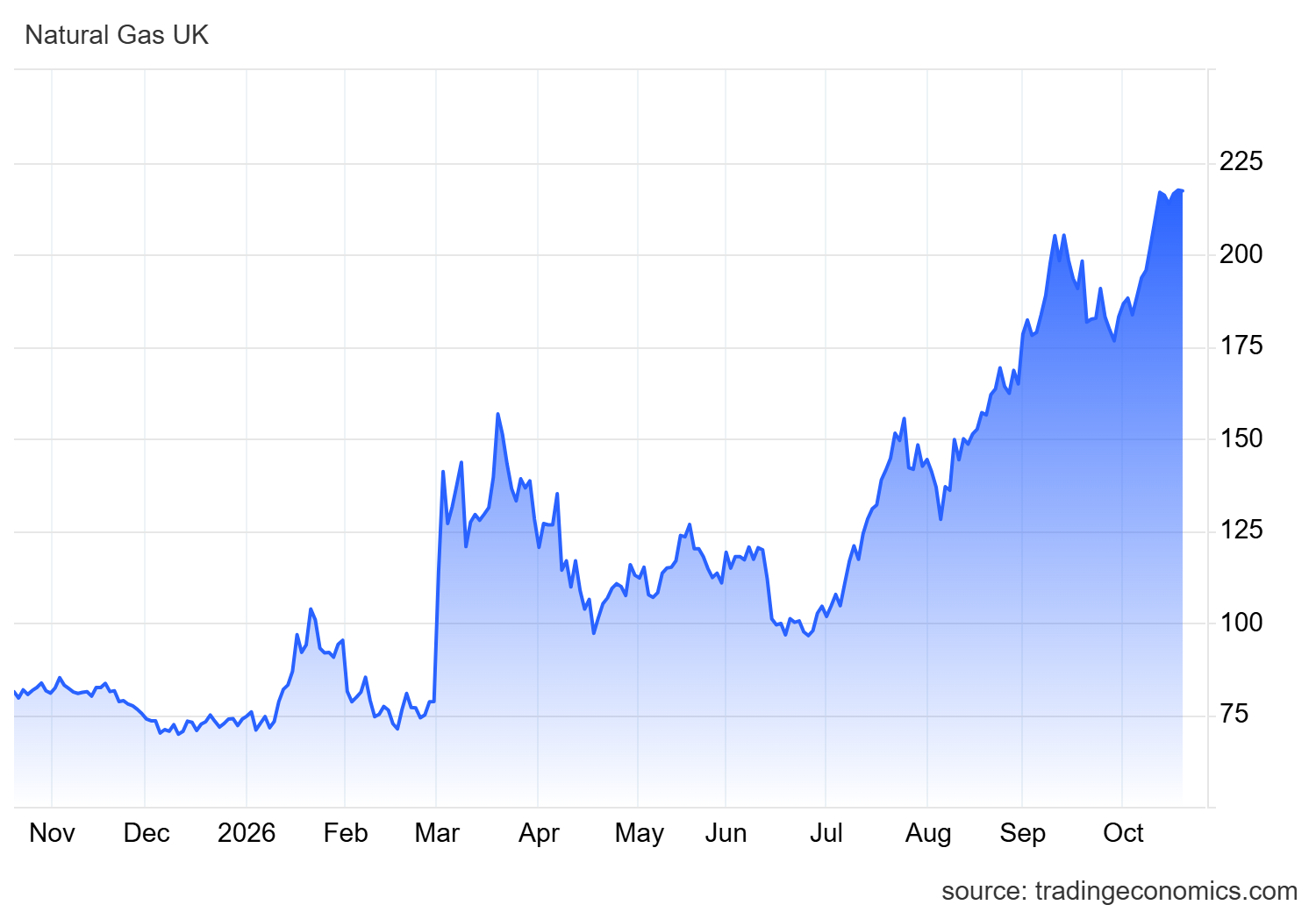
Source - Trading Economics
To get an idea of the changes in wholesale prices from 2021 to 2026, check out the graphs below:
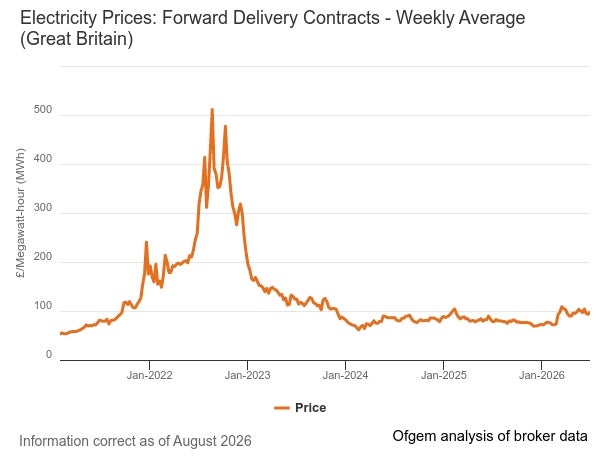
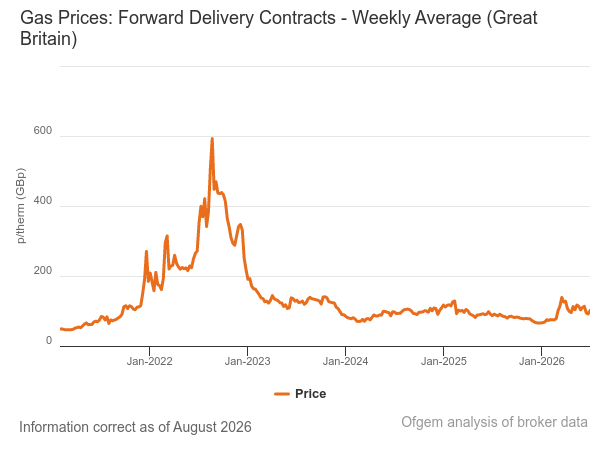
But what was behind this unprecedented price volatility?
What causes energy price volatility?
Supply and demand are major factors in price volatility.
When energy is in short supply, prices tend to go up, but they will usually drop again when supply is greater. It's the same with demand - prices go up when demand is high, but usually fall again when demand is lower.
Price volatility has been a big issue since 2020, as normal supply and demand issues have been coupled with a series of global events that pushed up prices further. The role of the pandemic in causing huge global supply and demand shocks can't be underestimated. Neither can the impact of the war in Ukraine and the Middle East.
Price volatility is always a concern for energy suppliers. This is why they typically trade on futures markets to help increase certainty about supply and prices for consumers. This means suppliers can buy or sell a set amount of gas or electricity at a specific price, for settlement on a specific date in the future.
When prices are so volatile that suppliers find it more difficult to trade, they may have to provide extra collateral to cover the risk of supply shortages. This caused some suppliers to pull out of providing prices when rates spiked in 2022. With no commercial cap in place, some suppliers increased out-of-contract gas rates by an average of 180%, and out-of-contract electricity rates by an average of 130% during this period.
What are out-of-contract rates?
Out-of-contract rates are a type of default tariff your supplier charges when your fixed deal ends and you haven't agreed a new one. They're usually much higher than fixed rates. Deemed rates work in a similar way and apply if you move into premises without agreeing a contract.
Learn more in our guide to avoiding deemed, out‑of‑contract rates and expensive contract gaps at renewal.
Here’s why these wholesale rates affect the price we all pay for gas and electricity:
- Suppliers buy energy from the wholesale market and then sell it to domestic and business energy customers
- When wholesale prices go up, energy suppliers increase their rates to cover the extra costs, and we’re all hit with higher energy bills
Switching to a fixed-rate deal can protect you against any mid-contract price rises, but you’ll probably find your rates will rise at the next renewal.
What is a fixed-rate business energy contract?
A fixed-rate business energy contract is a type of energy deal that locks in your unit rates and standing charges for a set term. Terms usually run from one to five years. Your unit rates stay the same, even if wholesale prices rise.
Learn more in our guide: fixed vs variable energy tariffs: Which is right for your business?
Why are business energy prices so high?
Supply and demand issues push up wholesale energy prices (that's the amount your provider pays energy generators for the gas and electricity they supply to your business).
Rising wholesale costs are often the biggest factor in rising energy prices. Here are some reasons why UK energy prices shot up and remain the highest in Europe.
Lower renewable energy generation
Low winds, coupled with outages at some nuclear power stations, mean that a higher percentage of our electricity generation is using gas during its production. If you're on a green energy deal that provides 100% renewable electricity, you'll still see your rates increase. This is because the way the UK energy system works means that the price of renewable energy is tied to the price of gas - if gas prices go up, so do renewable energy prices.
Low gas reserves
The UK has some of the lowest gas reserves in Europe, which means there’s almost no way of stockpiling gas to use it when needed. Capacity is equivalent to roughly 2% of the UK’s annual demand, compared with 25% for other European countries and as much as 37% in Europe’s four largest storage holders.
Insufficient government support
The energy price cap has been in place since 2019, but it's unclear how successful it has been. Although it has helped stabilise prices in times of high volatility, prices have often bunched around the level of the cap, limiting customer choice.
Business energy has never had a price cap. The Energy Bill Relief Scheme and Energy Bills Discount Scheme ran from October 2022 to March 2024. There's no general support scheme for business energy now. From 1 October 2026 to 31 March 2027, the government removed VAT from household electricity.
Small businesses that already qualify for the reduced 5% VAT rate on electricity also get the 0% rate. Most businesses pay 20% VAT on energy, so they won't see this cut. Find out more in our guide to VAT on business energy.
Issues with the energy market
65 UK energy suppliers have gone bust since 2021, affecting around 6.3 million customers. This is largely down to many of them having a business model that couldn't cope with an increase in wholesale prices.
When suppliers go bust, consumers help to absorb the cost through higher bills. For instance, when Bulb ceased trading, it was such a big supplier - providing power to around 1.5 million homes and businesses - that the government placed it into 'special administration' instead of going through the 'supplier of last resort' process.
Initial estimates suggested this process would cost £2.2 billion over two years, but figures from the Office for Budget Responsibility (OBR) show that an extra £4.6bn has been spent on handling the company, which will bring the total to £6.5 billion. This could add as much as £200 on to annual household energy bills.
UK energy prices are also affected by global events.
How do global events impact energy prices in the UK?
The UK energy market doesn’t operate in a bubble. Global events, from political tensions to extreme weather, can quickly ripple through to your gas and electricity bills. Here’s how it happens.
Global gas prices
The UK imports a lot of gas, especially liquefied natural gas (LNG) from the US, Qatar, and Norway. When global supply gets disrupted by wars, sanctions, or bad weather, the price of gas can soar.
Because gas powers a big chunk of our electricity, higher gas prices often mean higher energy bills. For example, the Russia-Ukraine conflict cut Europe’s gas supply and sent UK prices soaring, even though Britain wasn’t a major buyer of Russian gas.
In 2026, disruption in the Strait of Hormuz has cut LNG shipments from the Persian Gulf. Around a fifth of the world's LNG passed through the strait before the conflict. That leaves European and Asian buyers competing for fewer cargoes.
Oil prices push up costs
Oil plays a smaller role in UK energy generation, but it still matters. When oil prices rise, for example, due to OPEC production cuts or tensions in the Middle East, transport and supply chain costs climb too. In some cases, gas prices are linked to oil, meaning costs can rise together.
Extreme weather disruptions
Storms, droughts, and freezing winters can damage energy infrastructure or boost demand overnight. A cold snap across Europe (remember the Beast from the East in 2018) can drain gas supplies and force prices up across the UK.
Supply Chain Setbacks
Pandemics, shipping delays, and global crises can hold up new energy projects, like offshore wind farms or gas terminals. When there’s less supply on the market, prices stay higher for longer.
Currency Fluctuations
Energy is priced globally in US dollars. So if the pound (£) falls in value, it costs more to import gas and oil. Those higher costs can trickle down into your bills.
Market Volatility and Speculation
Global traders react quickly to headlines, not just facts. Speculation about shortages or political risks can spike energy prices before anything even happens. This volatility filters through to the UK’s wholesale market, driving supplier costs higher.
Life after lockdown
An increase in demand as lockdown restrictions eased across the globe. There's more on that in the section below.
How did the pandemic affect energy prices?
Let's quickly go back to the first lockdown of early 2020, when a drop in demand saw energy prices drop to their lowest ever levels. Although wholesale prices had been dropping since hitting a high of £67.69 per Megawatt-hour (MWh) in September 2018, things bottomed out at just over £24 per MWh in April and May 2020, at the height of the first lockdown.
Prices steadily increased in late 2021, when we saw some massive spikes. An increase in demand was a big driver of the price hikes.
A greater need for energy since the crash of spring 2020 saw gas prices increase more than fivefold and return to pre-pandemic levels.
For the wholesale electricity market, there has been a reduction in available power supplies compared to last year. When combined with higher gas prices, this has led to an increase in the wholesale price of electricity.
An increase in network and policy costs also pushed prices up.
Higher electricity distribution and transmission costs have driven a rise in network costs, as has an increase in policy costs, such as the Renewable Obligation (RO). For reference, the RO is a levy placed on all licensed electricity suppliers to encourage them to source a proportion of the electricity they supply from renewable energy sources.
The pandemic also saw more energy suppliers hit by 'bad debt ', and many lost money because customers simply couldn't afford to pay their energy bills.
Why are renewable energy prices so high?
If you're on a green deal that offers 100% renewable energy, you might be wondering why your prices are shooting up even though no gas is used to generate it.
It's all because of the way the UK's energy system works. Renewables generated a record 55.8% of the UK's electricity between April and June 2026. But we still rely on gas-powered plants to generate some of our electricity.
Wind alone produced 27.9% of UK electricity in that quarter, more than the 26.8% from gas. But gas plants still often set the wholesale price for everyone.
And that's where the pricing issues come from. Energy prices are set using a system called 'marginal cost pricing'. In short, this means that the most expensive type of energy is used to set the price for all types of energy, including renewables.
Even if you're on a plan that delivers 100% renewable energy, the price of your electricity is set not upon the cost of wind or solar generation, but on the cost of the last source used to meet demand. As gas-powered stations are used to top up electricity demand in the UK, so the cost of gas-powered electricity is used to set the price of all electricity.
So, when gas prices spike, you can bet that electricity prices won't be far behind.
Newer renewable and nuclear projects are paid through Contracts for Difference. This means the cost of their electricity isn't tied to gas prices. Instead, generators get a fixed, pre-agreed price for the low-carbon electricity they produce while the contract runs.
What is a Contract for Difference (CfD)?
A Contract for Difference is a type of government-backed deal that pays a low-carbon generator a fixed “strike price” for its electricity. If market prices fall below that price, the generator gets a top-up. If market prices rise above it, the generator pays the difference back.
This decoupling of costly global fossil fuel prices from electricity produced by cheaper renewables should help ensure consumers benefit from lower prices when switching to lower-cost, clean energy sources.
You can find out more in our guide to how energy is bought and sold in the UK.
Will business energy prices go down in 2026 or 2027?
Energy prices were expected to fall in 2026. But the conflict involving Iran has created instability in the Middle East, leading to supply concerns and more market volatility. This continues to change daily and could keep affecting the UK energy market
But prices are still expected to be high for many businesses, as higher non-commodity costs will make up nearly 60% of a typical business electricity bill, according to reports from Cornwall Insight.
What are non-commodity costs?
Non-commodity costs are a charge on your energy bill that covers everything except the energy itself. They include network charges, government levies and the Climate Change Levy.
Find out more in our guide to non-commodity costs & the energy triad period.
And there's now the added complication of further destabilisation in the Middle East.
Looking ahead to early 2027, the signs point upwards for now. Cornwall Insight's first forecast puts the January 2027 domestic price cap 9% higher than October's level. The domestic cap doesn't set business rates. But it reflects the same wholesale costs your supplier pays.
Should you fix your energy prices in 2026?
Fixing your energy rates could help you take control of your costs in an unstable market and protect against future price rises. Although we can't predict what energy prices will do, tensions in the Middle East have pushed up global gas and oil prices. Historically, that drives higher energy prices here in the UK.
Now could be a good time to lock in rates, not least because of the geopolitical situations that could lead to more volatility.
If you're unsure what to do, start a business energy price comparison by clicking the button on the right to see how current rates compare to your renewal offer. We only need your postcode to run a price comparison of rates from our panel of trusted UK suppliers.
When you get a quote with Bionic, our experts compare rates from trusted UK suppliers for you. You could see how your renewal offer stacks up in minutes, without chasing suppliers yourself.
What if you can't afford to pay your energy bills?
If you can't afford your business energy bills, you should consider speaking to your supplier as soon as possible about a repayment plan. If you don't work something out with your supplier within 30 days of your missed payment, they can start action to disconnect your energy supply.
For more information, check out our guide to business energy bills.
Will energy prices ever come down?
Although prices fell dramatically after the spike in 2022 and were expected to fall in 2026 (the Middle Eastern conflict has made this less likely), they're still much higher than pre-pandemic levels. They may never return to those levels, and fixing your rates is one way to protect against price volatility.
What can you do to keep your business energy bills low?
One way to shield your business from out-of-contract rates and future price rises is to lock in a fixed rate.
To get a quote tailored to meet the needs of your business, pop your postcode in the box on our business energy page, and we'll call you back to talk you through your options.
If you want to help cut your business energy bills, it also helps to think about how and when you’re using gas and electricity. So, consider the following:
- Assess when you’re heating your premises
- Switch appliances off
- Pay attention to the weather
- Install a smart meter to save
- Be mindful of water costs
- Turn off lights when not in use or fit light sensors
- Encourage all staff to be energy-aware
- Draught-proof your building
- Go paperless as much as you can
- Request an energy audit
For more detailed information, check out our blog on how to save business energy (and money).
But it pays to be realistic. Even if you put in place all of the energy-saving measures possible and cut your usage right down, there’s still a minimum amount of energy you need to use to keep your business running, so you might still feel it on your balance sheet if your energy rates rise.
Can you predict your energy bill?
You might think that, in theory, you could predict your energy bill before you receive it. But it’s more complicated than just figuring out how much energy you have used because taxes and levies are also added into costs.
To find out more about how to read your business energy bill and calculate costs accurately read our guide to understanding business energy bills.
Things to think about when choosing an energy deal
Not all business energy tariffs are the same - if you choose the wrong one, your business will pay too much for gas and electricity.
And because signing up to a business energy deal means you're locked in for the duration of the contract, you could be paying too much for anything up to five years.
This might leave you wondering whether it's worth bothering at all - here's why it definitely is worth comparing business gas and business electricity deals.
If you’ve never switched business energy suppliers, your current provider will have you placed on ‘out-of-contract' rates, which can cost up to twice as much as contracted rates (even more in the current market).
When switching, you'll need to bear in mind that the rates you're offered will depend on things like the amount of energy you use, the location of your business premises, and whether or not your business is in good financial shape - a poor credit score could see you paying higher rates, as your business is seen as a higher risk.
Remember that energy suppliers don’t offer dual fuel contracts. Even if you agree to a gas and electricity deal with the same supplier, these will still be two separate energy contracts.
How to switch business energy suppliers
The quickest and simplest way to find the best business energy deals is to speak to the tech-enabled human experts at Bionic.
Just give us your business name and postcode, and we'll use smart data and our own expertise to find the best business gas and business electricity tariffs for your business in a matter of minutes.
To get started, pop your business postcode in the box at Bionic.co.uk, or give us a call on 0800 086 1326.
Our business energy experts will then search for the best deals from our panel of trusted and quality UK energy suppliers, and then help you choose the right energy tariff over a short call.
You just need to decide which deals you like best, and we’ll take care of the rest. And there's no need to worry about renewals either, as we can find you the best deals year after year.
Frequently asked questions about business energy prices
Got more questions on energy prices? Here are the answers to some of the most frequently asked questions.
Why are business energy prices so high right now?
Business energy prices are high mainly because wholesale gas prices have risen sharply in 2026. Disruption in the Strait of Hormuz has cut supplies of liquefied natural gas to Europe. Gas also often sets the price of UK electricity, so both fuels rise together. Network charges and government levies add to the cost too.
Does the energy price cap apply to business energy?
No. Ofgem's energy price cap only covers household standard variable tariffs. Each supplier sets its own business energy rates, which you agree to in your contract. That's why comparing quotes before your renewal could make a big difference.
Will business energy prices go down in 2027?
Nobody can say for certain. Wholesale prices depend heavily on events in the Middle East and LNG supplies this winter. Analysts expect the domestic price cap to rise in January 2027, which points to higher costs for now. A lasting deal to reopen the Strait of Hormuz could bring prices down.
Is now a good time to fix my business energy prices?
We can't predict the market, and the right timing depends on your business. A fixed-rate contract could protect you from further rises during your contract term. If your contract ends soon, you should consider comparing quotes before you move onto out-of-contract rates. You can then decide with real prices in front of you.
What happens when my business energy contract ends?
If you don't agree to a new deal, your supplier will usually move you onto out-of-contract rates. These rates are often much higher than fixed rates. Your supplier should send you a renewal notice before your contract ends. Comparing quotes when that notice arrives could help you avoid paying more.
How much does business electricity cost per kWh in the UK?
October rates for business electricity are roughly between 26p and 29p per kWh, depending on business size and usage. For more information, visit our business electricity page.
Does the VAT cut on electricity apply to my business?
It might. The government removed VAT from household electricity from 1 October 2026 to 31 March 2027. Small businesses that already qualify for the reduced 5% VAT rate on electricity also get the 0% rate. Most businesses pay 20% VAT on energy and won't see a change.
How can I compare business energy prices quickly?
You can start a business energy comparison with Bionic using just your business postcode. Our experts compare rates from our panel of trusted UK suppliers and talk you through your options. If you choose a deal, we handle the switch for you. Getting started usually takes a few minutes.