












Is there an energy price cap for business?


The energy price cap will increase by about 4% from October 2026. This will add around £5 a month - or £60 a year - to the 'typical' household energy bill, up from £1,663 to £1,729.
If those figures look a little different to last time, that's because Ofgem has updated its definition of a 'typical' energy user.
Under the old system, a typical dual-fuel household paying by Direct Debit would be hit with an annual bill of £1,941 under the new price cap. This is up from £1,862 and the highest rate since April 2022, excluding those months where the "Energy Price Guarantee" was introduced alongside the cap (there's more on that below).
In any case, that's a total increase of about 17% on household energy bills since the summer - a lot for already stretched households to absorb. Typical households now pay around £600 a year more on energy than before Russia invaded Ukraine. This has led to unpaid bills and charges, with energy firms expecting the total to reach £7 billion by the end of the year.
The increase is due to ongoing global energy market volatility. Higher wholesale gas prices driven by conflict in the Middle East are affecting the prices we pay for both gas and electricity.

Speaking on BBC Radio 4 on the day of the announcement (August 26, 2026), Neil Kenward, Interim Director General for Markets, said of the increase, "This is an increase today of just under 4% - so 3.6% - that's about £5 per month on the average bill.
"And the main driver of that is the rise in international gas prices, which has restricted supplies out of the Straight of Hormuz. That feeds directly into our gas bills, but also contributes to higher electricity bills because we still burn some gas for electricity [production]."
This means higher energy bills for around 19 million households on variable-rate tariffs in England, Wales, and Scotland. And experts are forecasting another price rise in October.
But here's the important bit for anyone running a business - none of this affects you directly.
There is no energy price cap for business customers in the UK. Your gas and electricity bills are determined by your contract and consumption, not by the Ofgem cap that protects domestic customers.
That means whether you're running a café, a salon, a manufacturing unit or an office, your energy costs are entirely unprotected by the household price cap.
Unlike domestic energy customers, businesses receive no government support for their energy bills. Although the Energy Bill Relief Scheme and Energy Bills Discount Scheme were introduced to help businesses during the height of the energy price crisis, no further government support has been given since these schemes ended in March 2024.
With no live support schemes or cap in place, it is even more important for SMEs to compare business energy quotes regularly and avoid rolling onto expensive deemed or out-of-contract rates.
Below, there's more on how both schemes worked, but let's first look at how the energy price cap works and whether it affects business energy prices.
Five-point summary on the energy price cap and your business
- There is no business energy price cap. The Ofgem price cap only applies to domestic customers on standard variable or prepayment tariffs. Business energy prices are set by commercial contracts and wholesale market movements.
- The October 2026 domestic cap is £1,729 for a typical household - a 3.6% increase from July 2026's £1,663. This reflects an increase in wholesale prices caused by the war in the Middle East.
- All government business energy support schemes have ended. The Energy Bill Relief Scheme and Energy Bills Discount Scheme both closed in March 2024, and no further schemes are currently planned.
- Being on out-of-contract or deemed rates can cost your business significantly more, typically 20–50% above a negotiated fixed deal, and in some cases as much as 70% more depending on your supplier and consumption.
- The most effective protection for your business is a competitively priced fixed-rate contract. Comparing deals at least three to six months before your renewal date gives you the best chance of locking in a good rate.
What is the energy price cap?
The energy price cap sets the maximum price that energy suppliers can charge domestic customers on prepayment and standard variable tariffs.
The cap is reviewed quarterly by Ofgem, the UK's energy regulator, and adjusted to reflect changes in:
- Wholesale energy prices (the price suppliers pay for the energy they sell on)
- Network and distribution costs (the cost of maintaining the grid)
- Policy and government levy costs (such as the Renewables Obligation and Energy Company Obligation)
- Operating costs for suppliers
- VAT (charged at 5% for domestic customers)
Although usually described as the annual bill an average household on a dual fuel tariff would pay, the cap is actually a limit on the standing charge and unit rates. This means that household bills will be higher or lower than the advertised cap, depending on how much energy they use.
This means that, crucially, the cap does not limit the total amount a home can be billed – if you use more units of gas or electricity than the “typical” consumption used to set the cap, you will pay more than the quoted annual figure.
Because the business energy market works differently – with bespoke contracts, higher usage and varied meter types – Ofgem has not extended the price cap to non-domestic customers.
What is the current energy price cap level?
From October 1, 2026, to December 31, 2026, the energy price cap rates below will apply:
- Electricity - 26.32p per kWh (unit rate) and 54.83p per day (standing charge)
- Gas - 7.97p per kWh (unit rate) and 29.68p per day (standing charge)
When prices are adjusted for annual consumption, this means an average household on a standard variable tariff paying by Direct Debit can expect to pay £1,729 a year for gas and electricity. This is an increase of about £60 on the previous cap.
The current price cap runs until September 30, 2026, and the rates below apply:
- Electricity - 26.11p per kWh (unit rate) and 57.19p per day (standing charge)
- Gas - 7.33p per kWh (unit rate) and 29.04p per day (standing charge)
Remember, these headline annual figures apply to a “typical” domestic customer using a set amount of energy each year - your home bills will be higher or lower depending on property size, insulation, heating type and how efficiently you use energy.
How and why has Ofgem changed the definition of a typical energy user?
Ofgem cut its benchmark for a typical household's energy use, known as Typical Domestic Consumption Values (TDCVs), from July 1, 2026. The change was introduced to reflect real drops in household energy use.
How the definition changed
- Electricity - Average use fell by 7% to 14%, dropping from 2,700 kWh to 2,500 kWh a year
- Gas - Average use fell by 15% to 20%, dropping from 11,500 kWh to 9,500 kWh a year
- These figures come from the Ofgem Consultation. They set the baseline for the annual price cap and help you compare tariffs when you don't know your actual usage.
Why the definition changed
- Lower bills response - Households cut back on energy use to manage bills after the energy crisis
- Energy efficiency - More homes now use insulation, smart thermostats, and efficient appliances
- Warmer weather - Milder seasons cut heating demand.
Will the energy price cap increase?
The price cap will increase by 13% from July 1, 2026, and experts at Cornwall Insight are predicting another winter increase in October.
Tim Jarvis, Ofgem CEO, put the price rises squarely down to conflict in the Middle East: "Today’s price change reflects continued volatility in global energy markets. This means higher wholesale gas prices, driven by ongoing conflict in the Middle East, is impacting the price we pay for energy. "
He went on to say: “We understand many will be concerned about rising prices. While energy use typically falls over the summer months, there are still practical steps households can take to manage costs, including exploring fixed tariffs or changing their payment method. Smart meter customers can also take advantage of half price or cheap electricity at the weekends.
“While our energy supplies remain secure, the best way to limit this exposure is by investing in our energy network. That's why we're unlocking the funding needed for the biggest transformation of our lifetime to deliver a system that is secure, resilient, and works for consumers across Great Britain.”
You can read more at the Ofgem website.
Wholesale energy costs still make up the largest portion of your energy bill, so the price you pay is still open to volatile prices.
The wholesale price is the amount suppliers pay for the energy they provide to homes and businesses. Ofgem figures show wholesale gas and electricity prices dropped steadily towards the end of 2025. There are more details in our guide to business energy price rises.
The way the energy market works also contributes to rising prices. Although many suppliers utilise renewable sources, the price of electricity is directly influenced by the price of gas. We explain why in our guide on how energy is bought and sold in the UK.
For business owners, this means your renewal quotes will still reflect underlying wholesale market movements even when the household price cap is falling, staying flat or rising more slowly.
As the price cap only affects domestic energy rates, fixing your business energy rates is the only way to protect against price volatility. Our main business energy page has a breakdown of this month's business energy prices.
Speaking to BBC Radio 4 following a previous price cap announcement, Tim Jarvis, Director General for Markets at Ofgem, recommended that consumers should switch from standard variable rate tariffs to fixed rate tariffs to save money: "We are starting to see the market returning, which is very much welcome, and I would very much urge people to shop around. We're seeing fixed-rate deals on the market now that are around £200 a year cheaper than the cap.
"Our advice to people would be to look at the fixed market because it does insulate you from this volatility and fluctuations in the price cap, and ensure that you know what you're paying. The price cap is a cap on rates and what suppliers can charge, but there are cheaper deals out there."
When is the next energy price cap review?
The energy price cap is reviewed every three months - February, May, August, and November. The new price cap is also implemented every three months - April, July, October, and January. According to Ofgem, the next round of price cap reviews will take place on the following dates:
- August 26, 2026 - period October 1, 2026, to December 31, 2026
- November 25, 2026 - period January 1, 2027, to March 31, 2027
- February 23, 2026 - period April 1, 2027, to June 30, 2027
These quarterly review points are useful markers for business owners to watch, as they can give a rough indication of where wholesale prices – and therefore future business contract offers – may be heading. But the level of the price cap has no impact on non-domestic energy rates.
What is the business energy price cap?
No. There is no business energy price cap in the UK, and there are no current plans to introduce one.
The complexity of commercial energy contracts and the difference in usage between businesses mean that a cap on business energy rates would be difficult to set up.
Unlike households, where most use gas and electricity for the same things but at different levels, the difference in how and when businesses use energy can be huge.
Although a fish and chip shop and a car mechanic both need electricity, how and when they use this power is completely different. This is why there are no ‘off-the-shelf’ options for businesses and contracts need to be tailored to meet individual needs.
This makes it more difficult to create a single blanket rate across all businesses, so there is no commercial energy price cap.
In practice, this also means that business electricity and gas contracts can run for longer fixed terms – typically between 1 and 5 years, depending on your usage and risk appetite.
Without a cap, non-domestic customers rolling onto deemed, default or out-of-contract tariffs can face significantly higher prices than those who negotiate a new fixed deal before their renewal date.
When the government did offer support, schemes were designed to reflect the complexity of commercial energy contracts. This meant financial support was offered to all sizes and types of businesses.
These schemes were time-limited and applied automatically via suppliers, so there is currently no need – and no option – for SMEs to apply for new government energy discounts.
Do we need a cap on energy rates?
Wholesale energy prices have been so volatile in recent years that households and businesses across the UK have been hit with record energy bills. A price cap is one way to help lower the amount customers pay for energy. But it’s not perfect.
The energy price cap was introduced in 2019 to limit the amount suppliers could charge households on credit meters for gas and electricity. This came two years after the Safeguard Tariff, which caps the unit rate suppliers can charge anyone paying for gas or electricity in advance using a prepayment meter.
The cap was brought in to end what (then Prime Minister) Theresa May described as “rip-off energy prices” that were being charged as a result of Britain’s “broken energy market”.
Although it does help to control prices, the problem with this system is that it causes prices to bunch around the level of the cap. When the cap was introduced, the number of cheap energy deals (those that cost less than £1,000 per year) dropped by 90% during 2018, falling from 77 at the start of the year to just eight by the end.
This made the domestic market a lot less competitive. The price cap was even cited as one of several reasons why some energy suppliers went bust or stopped trading over the last few years.
For the business market, a similar cap could reduce the number of specialist suppliers and innovative tariffs available to SMEs, while still not fully protecting high-usage or energy‑intensive organisations from fluctuations in wholesale costs.
How has the energy price cap changed?
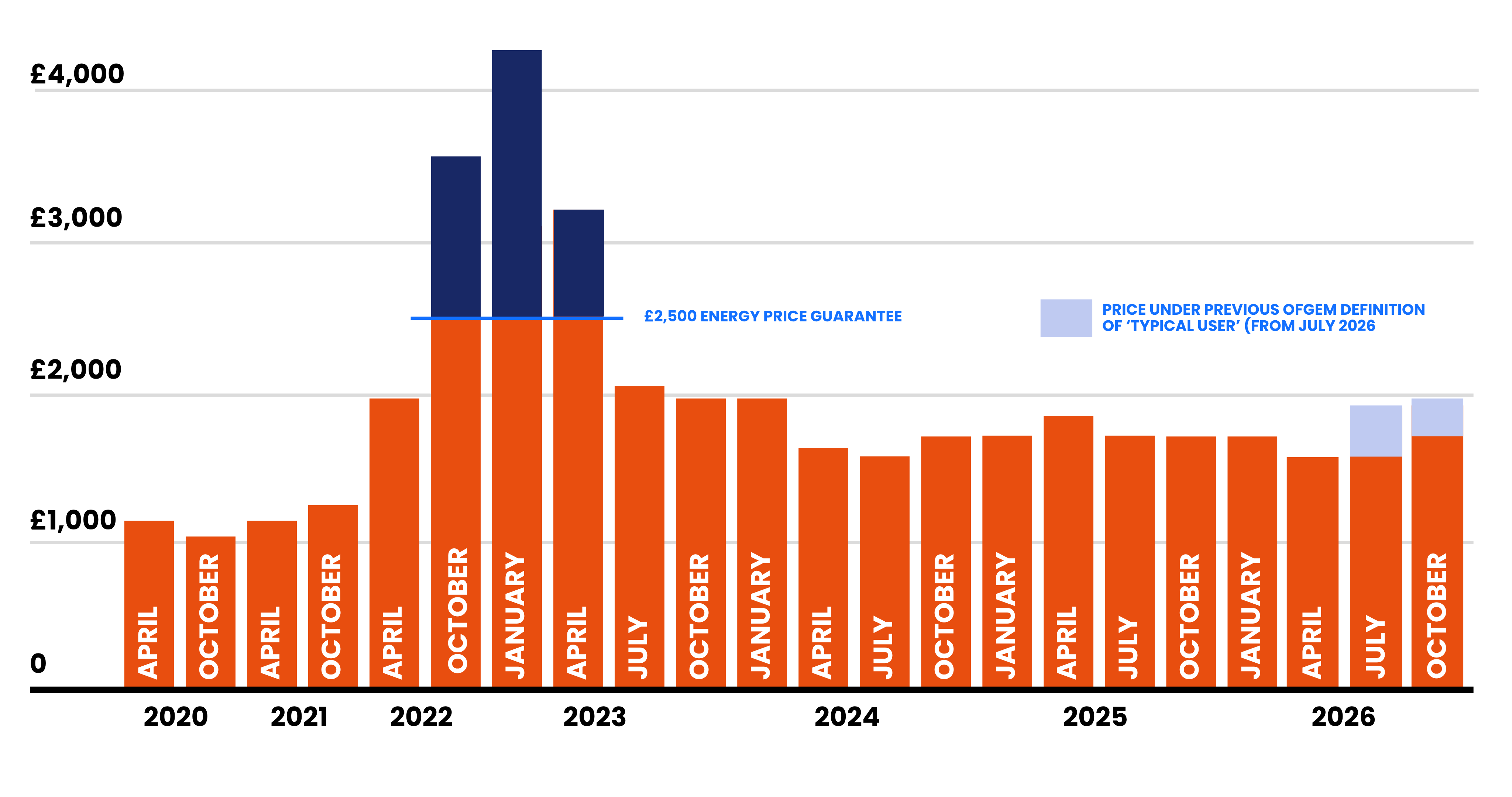
There have been many changes to the level of the energy price cap since it was introduced in 2019. It was originally updated every six months, but market volatility saw Ofgem switch to quarterly updates from the start of 2023.
It's also worth noting that, during the 2022–2023 crisis period, the Energy Price Guarantee effectively overrode the cap level for households by limiting typical annual bills, while non-domestic customers relied on EBRS and then EBDS rather than a unit-rate cap. There's more info on those schemes below.
| Date | Price cap cost | +/- |
| January 2019 | £1,137 | - |
| April 2019 | £1,254 | +£117 |
| October 2019 | £1,179 | -£75 |
| April 2020 | £1,126 | -£17* |
| October 2020 | £1,042 | -£84 |
| April 2021 | £1,138 | +£96 |
| October 2021 | £1,277 | +£139 |
| April 2022 | £1,971 | +£693 |
| October 2022** | £3,549 | £2,500 (used to cap unit rates) |
| January 2023** | £4,279 | £2,500 (used to cap unit rates) |
| April 2023** | £3,280 | £2,500 (used to cap unit rates) |
| July 2023** | £2,074 | £3,000 (used to cap unit rates) |
| October 2023** | £1,923 | £3,000 (used to cap unit rates) |
| January 2024** | £1,928 | £3,000 (used to cap unit rates) |
| April 2024 | £1,690 | -£238 |
| July 2024 | £1,568 | -£122 |
| October 2024 | £1,717 | +£149 |
| January 2025 | £1,738 | +£21 |
| April 2025 | £1,849 | +£111 |
| July 2025 | £1,720 | -£120 |
| October 2025 | £1,755 | +£35 |
| January 2026 | £1,758 | +£3 |
| April 2026 | £1,641 | -£117 |
| July 2026 | £1,663 (£1,862)*** | +£221 |
| October 2026 | £1,729 (£1,941)*** | +£60 |
Note: Energy Price Cap levels above are based upon an average household paying a supplier's standard variable rate tariff by monthly Direct Debit.
*Although the price cap appeared to have dropped by £53, the actual reduction was just £17 due to a change in the way Ofgem calculates 'typical' household use.
**A volatile energy market meant the Energy Price Guarantee was introduced alongside the Energy Price Cap. This ended in March 2024.
*** Ofgem changed the definition of a 'typical' energy user, so the lower annual averages now apply
What was the Energy Price Guarantee?
The Energy Price Guarantee was a government scheme that limited the price of gas and electricity for domestic consumers in the UK. It was in place from October 2022 to March 2024.
It is often cited as capping household energy at £2,500 a year, but this figure was based on an average household paying by Direct Debit. The actual capped unit rates were:
- 34.00p per kWh of electricity
- 10.30p per kWh of gas
Standing charges were also capped at:
- 46.35p per day for electricity
- 28.49p per day for gas
This means that bills were higher or lower than the quoted £2,500, depending on energy usage and payment methods (paying by Direct Debit is usually the cheapest option).
What was the Energy Bill Relief Scheme?
The Energy Bill Relief Scheme (EBRS) is now closed. The Energy Bill Relief Scheme was a discount on business energy bills that ran for six months between October 1, 2022, and March 31, 2023. EBRS worked differently from a price cap. Instead of capping rates, the government limited the wholesale price that suppliers pay to generators for energy.
The savings made by suppliers were passed on to consumers by a cut in the wholesale cost part of the unit rate on all business energy contracts signed after December 1, 2021. The discount was also applied to businesses on flexible, out-of-contract, and deemed rates.
What businesses were eligible for the Energy Bill Relief Scheme?
The Energy Bill Relief Scheme was applied to all non-domestic contracts. This means it was open to all businesses, including voluntary and public sector organisations.
There were some exceptions, such as power stations, grid-level battery storage facilities, or any business that uses gas or electricity to generate power that will be sold back to the grid.
The only other condition was that all eligible businesses were on one of the following contracts:
- An existing fixed price contract agreed on or after December 1, 2021. This includes contracts signed while the scheme is running.
- Deemed rates, out-of-contract rates, or a variable tariff
- Flexible purchase or a similar contract
Check out our guide for more information on the available types of business energy contracts.
What was the Energy Bills Discount Scheme (EBDS)?
The Energy Bills Discount Scheme (EBDS) replaced the Energy Bill Relief Scheme (EBRS) on April 1, 2023. The new scheme offered a discount on non-domestic gas and electricity unit rates. The unit rate is measured in kilowatt-hours (kWh) and is the amount your business pays for each unit of energy it uses.
Who was eligible for EBDS?
EBDS was available to non-domestic customers on fixed-price contracts that were agreed on or after December 1, 2021, as well as deemed and out-of-contract rates.
What to do if you can’t pay your business energy bills
If you're struggling to pay your business energy bills, then you should contact your supplier as soon as possible. Under Ofgem rules, the supplier must offer a reasonably affordable payment plan. You can find out more in our guide to business energy bills.
Should you fix your business energy rates?
Although we can't predict what will happen to energy prices, fixing your rates is the only way to guarantee bill stability by locking in a consistent price for your energy and the current discount.
Tim Jarvis, Director General of Markets, at Ofgem, echoed this when speaking on BBC Radio 4, "Prices are still high compared to historical norms. There’s a lot of volatility. The changes in prices are as a result of the changes in international markets. It does make this market difficult, so I would recommend people try and switch to protect themselves from these fluctuations.”
That’s where the tech-enabled experts at Bionic can help. We’ll compare rates from a panel of trusted UK suppliers to get our best available fixed rates for your business. If you need to fix your rates, head to our Business Energy page to start your price comparison.
How to cut your energy costs beyond the contract
Negotiating a better contract is the most impactful single action you can take on business energy costs — but it's not the only lever available. Combining a competitive contract with sensible energy efficiency measures can reduce your bills further.
Some practical steps that many SMEs overlook:
- Get a smart meter installed. Smart meters send automatic readings to your supplier, eliminating estimated bills and ensuring you only pay for what you actually use.
- Check your VAT rate. Businesses consuming less than 33 kWh of electricity per day (or 1,000 kWh per month) may qualify for the reduced 5% VAT rate rather than the standard 20%.
- Review your Climate Change Levy (CCL) eligibility. Businesses purchasing electricity from renewable sources, or with certain low-consumption profiles, may qualify for Climate Change Levy exemptions or relief.
- Consider an energy audit. Professional business energy audits typically identify 10–20% savings opportunities through simple behavioural and equipment changes.
- Install LED lighting and smart controls. Lighting often accounts for 20–40% of a commercial electricity bill — switching to energy-efficient lighting like LED upgrades can cut this by 50–80%.
- Explore solar panels. On-site solar panel generation can significantly reduce grid electricity costs, with surplus electricity sold back via the Smart Export Guarantee (SEG).
- Look at half-hourly metering. If you use over 100 kW of electricity at peak demand, a half-hourly meter may allow you to access time-of-use tariffs, where you pay less during off-peak hours. All homes and businesses will be metered every 30 minutes under Market-Wide Half-Hourly Settlement (MHHS).
Frequently asked questions about the business energy price cap
Got more questions about the energy price cap and your business? See if the answers are below:
Is there a price cap for small businesses in the UK?
There is no price cap for business energy in the UK — the Ofgem cap only protects domestic customers on standard variable or prepayment tariffs. Small businesses, including sole traders and microbusinesses, are subject to commercial contract terms and have no equivalent regulatory price protection.
What is a deemed rate, and why does it matter for businesses without a price cap?
A deemed rate is the default tariff a supplier charges when a business moves into a property without an existing contract or lets its fixed deal expire without renewing. And because there is no cap on business energy, these rates are typically among the most expensive available. Signing a fixed-term contract before your renewal date is the most effective way to avoid being rolled onto a deemed rate.
Does the Ofgem price cap affect what businesses pay for electricity and gas?
The Ofgem price cap has no direct effect on business electricity or gas bills. It is a ceiling on the unit rates domestic suppliers can charge household customers, not a limit on commercial tariffs. However, the cap can be a useful indirect signal of wholesale market direction, since both domestic and business rates are ultimately influenced by the same underlying gas and electricity prices.
What replaced the Energy Bill Relief Scheme for businesses?
The Energy Bill Relief Scheme (October 2022 to March 2023) was replaced by the Energy Bills Discount Scheme (April 2023 to March 2024), after which no further government support scheme for business energy has been introduced. Businesses currently have no access to any government-backed discount or cap on their energy costs.
How often do business energy prices change compared to the household price cap?
Unlike the household price cap, which is updated on a fixed quarterly schedule, business energy prices can change at any time based on wholesale market movements, contract type, and when a business chooses to renew. Businesses on flexible or out-of-contract rates are exposed to price changes in near real time, which is why fixing rates on a multi-year contract provides far greater cost certainty.
Can energy-intensive businesses get any special protection from high energy prices?
There is currently no live government scheme offering energy cost protection specifically for energy-intensive businesses in the UK, following the end of the EBRS and EBDS in March 2024. Some energy-intensive industries may be eligible for exemptions or reductions on certain non-commodity charges — such as the Climate Change Levy or network cost elements — so it is worth checking with an energy broker whether your sector qualifies.
Why does the price of electricity track the price of gas even when renewable generation is high?
In the UK, the wholesale electricity price is largely set by the most expensive form of generation needed to meet demand at any given moment, which is almost always a gas-fired power station. This means that even when wind and solar are generating abundantly, electricity prices remain tied to gas market movements, a mechanism known as marginal pricing; it is one reason why businesses feel the impact of global gas price volatility even if their supplier uses renewable sources.
What is the difference between a fixed-rate and a variable-rate business energy contract?
A fixed-rate business energy contract locks in your unit rate and standing charge for the duration of the agreement, typically one to five years, giving you protection against wholesale price rises and making budgeting more predictable. A variable-rate contract fluctuates with market conditions, which can occasionally mean lower bills when prices fall, but leaves your business fully exposed when prices rise, and there is no cap to limit how high those rates can go.